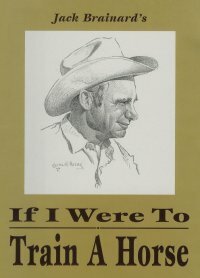
IF I WERE TO TRAIN A HORSE Book by Jack Brainard
Price: $30.00
Availability: temporarly out of stock
Legendary trainer, breeder, and teacher Jack Brainard is a master storyteller. He will open your mind to the challenges, enjoyments, and fulfillment of training young horses. I know of no horse trainer who is a greater student of horsemanship than Jack. He has continued to improve his own skills and knowledge through his associations with master horseman like Tom Dorance and Ray Hunt, and by his intensive reading of classical horsemanship. This coupled with 50 years of training horses and producing some of the world's greatest reining horses has given him the vast wisdom that he shares here with you. You will be amazed at how he takes complex training procedures and simplifies them through his understanding of the horse's mind and movements.
This book reads like Jack is having a conversation with you. Without realizing it you will be getting lessons in equine history, anatomy, psychology and a touch of philosophy but most importantly, he conveys to you in easy to understand language how to develop the following attitudes and/or maneuvers in your horse:
Impulsion, Collection, Circles
Relaxation, Forequarter Control, Lead Changes
Willingness, Hindquarter Control, Stops
Bit Acceptance, Straightness, Spins
You will also appreciate the original drawings of noted western artist, Justin Wells, and Jack's reflections on living his life as a horse trainer. Jack has been a friend, mentor, and inspiration to me. I am so glad that he wrote this much needed book and I hope you enjoy it as much as I have.
Larry Kasten
Professor and Equine Program Director
University of Wisconsin - River Falls
Preface from If I Were To Train A Horse
Since horses have been the foremost aspect of my life and after spending 70 years with them, I feel qualified to reflect on my experiences with them and with the industry in general.
Needless to say, I have seen changes, most of them major. I have seen the Quarter Horse emerge as a breed now approaching four million horses (my first Quarter Horse had a registration number of 369). I remember when Paints were only spotted horses and the ranchers called them “Indian Ponies”. I watched the Appaloosa breeders struggle to publish a studbook in Moscow, Idaho, and I watched cuttings grow from spectator events to million dollar contests.
Yes, I have seen some changes and it's fun to talk about them, especially if I can find someone as old as myself who started when I did.
Fabulous breeding farms have sprung up coast-to-coast, costing billions of dollars and they are producing horses that are superior - horses that we never dreamed of 50 years ago. We have a show system unrivaled anywhere in the world and we can exhibit and compete any day of the year. I can remember when one show a year was a big deal. Believe me, we have come a long way in my lifetime.
Since training horses has dominated my thought processes and my goals have usually been along those lines, it only seems natural that I have cause to reflect on the training aspects and the changes I have seen. Luckily I have had the opportunity to watch and become acquainted with many of America's best horsemen. In addition I have also had the misfortune to watch many bad ones. I have learned from both, however.
So this is what this book is about: training a horse. There are thousands of books on the subject, all written by qualified people. My hope is that in the pages of this book, readers will find information, ideas, schedules, techniques, cues, aids, controls and a philosophy, which will enable them to ride a better horse.
Will Rogers once said, “Experience is another word for mistakes.” His definition, being valid, means that I have had a tremendous amount of experience. It is my hope that through the pages of this book, readers will profit from my experience and thus avoid the myriad of mistakes that I have committed.
This narrative is grounded in the belief that the slow way is usually the fastest and that the horse is deserving of more consideration than he gets.
I have been fortunate to become acquainted with Pat Parelli and with his ideas, programs and methods. He has tremendous foresight, vision, and ideals and has probably done more to help the average horseman, and his horses than any man in existence. I look forward to a long relationship with Pat because he is certainly on the right track.
Above all, if I can save some old colt from an unnecessary whipping, spurring, pulling or false training process, it will have been worthwhile and I'll bet the colts will thank me.
I also know that through the pages of this book, many readers will acknowledge that I surely needed some assistance in refining my English prose and that they hope my horse knowledge is better that my literary prowess. All I can say is that most horse trainers handle horses better than words and punctuation marks.
Here is a nice started 2-year-old. Climb on and let's see what we can do with him.
Click HERE to be added to Jack's e-mail list and be kept up to date with where Jack will be.
♦ Look for Jack on his group on Facebook
Jack Brainard Advanced Horsemanship ♦
Copyright © 2015 Jack Brainard Advanced Horsemanship
All Rights Reserved